
Salt of the earth
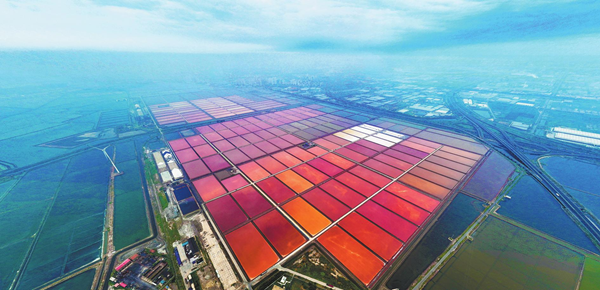
In the vast, sun-drenched coastal expanse of Tianjin's Binhai New Area in early autumn, the landscape shimmers. Here, where the waters of the Bohai Sea meet the land, lies the Tianjin Changlu Hangu Salt Field, a place that has been continuously harvesting salt for over a millennium.
Marking its 1,100th anniversary this year, the Hangu Salt Field is no longer defined by the arduous labor of ancient salt masters. It is now a leading-edge industrial park, a national cultural heritage site, and the host of the world's largest "salt-light complementary" power station — a stunning testament to China's push for green, high-quality development. The story of this field is the story of China itself: an ancient industry reimagined for the 21st century.
Established in 925, the Hangu Salt Field is one of the largest sea salt production bases in the Changlu salt-producing area, with an annual production capacity of 1 million metric tons.
From the ancient method of boiling seawater for salt to today's intelligent production and integration of cultural tourism, this salt field is pioneering a new path of high-quality development for traditional industries.
"The first step in salt production is the intake of tidewater. That is, using pumping systems and the natural force of rising tides to channel seawater into the salt pans, where natural evaporation turns it into brine, the raw material for salt production," said Dong Shaosen, head of a crystallization zone at the Changlu Hangu Salt Field.
The salt pans are constructed following the terrain, which is higher in the west and lower in the east. The brine flows eastward along the slope through multiple evaporation ponds, exposed to wind and sun for over 300 days. During this process, its concentration gradually increases until it finally reaches the crystallization point.
Compared to the laborious traditional method of scraping soil to leach brine and boiling it in pans to form salt, modern salt production has achieved a leap forward in both efficiency and quality. One of the core innovations is plastic sheeting technology — a floating plastic cover system used to ensure ideal conditions at all times.
"When rainfall exceeding 5 millimeters is forecast, the plastic sheets are mechanically deployed along tracks to swiftly cover the entire crystallization pond, protecting the brine from dilution," said Dong.
"In the past, rainwater would directly fall into the ponds, and production was entirely at the mercy of the weather. Now, with plastic sheeting technology and modern salt harvesting systems, our production capacity and stability have significantly improved, enabling year-round crystallization," he said.
In 2020, the salt field established a high-end edible salt production base with an annual capacity of 300,000 tons. Centered on a dedicated manufacturing execution system, the base has achieved automation and digital management across the entire production process. This enables stricter quality control and meets market demand for high-quality edible salt.



Copyright ©
Tianjin Municipal Government. All rights reserved. Presented by China Daily.
京ICP备13028878号-35